Other iterations include the Auto-Takumar (1958 - 1962), Super Takumar (1962 - 1965), and Super-Multi-Coated Takumar (1965 - 1972).
The lens is a straightforward construction with 5 elements in 4 groups, which contributes to the lens's compact dimensions, and features a built-in retractable lens hood that helps against backlit shooting situations.
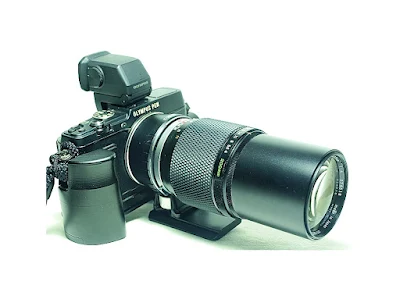
Had the lens mounted via a Leinox OM-M4/3 lens adapter, which came with a separate tripod mount (usable with other Leinox adapters as well) that makes it easy and convenient to use the lens at its equivalent of a 400mm telephoto lens on a 35mm full-frame camera.
The camera, one of the more successful 35mm AF film cameras of the 1980s, had advanced features packed into a very ergonomic package, won many awards, including the Good Design Award from the Ministry of International Trade and Industry of Japan, and was selected as the European Camera of the Year (1986).
The camera has 4 elements in 4 groups Canon 38mm F2.8 lenses with spectra coating, a programmed electromagnetic shutter with a shutter/aperture range from 1/8 second at F2.8 to 1/500 second at F16, and a DX-coded sensor that will set film speed automatically to ISO 50, 100, 200, 400, 800, or 1600. Active autofocusing is by a triangulation system with a near-infrared beam. A tilting foot on the bottom of the camera allows the camera to be placed on a flat surface while shooting upwards at an angle.
Though nice and enjoyable in every other way, the Canon Autoboy 3, however, does have a couple of quirks that might irk the user. First is the screwed-down battery compartment, which requires the use of a mini-screwdriver to replace the 2CR5 battery pack it uses. The other is the tiny rubber flash disable button located on the bottom of the camera that must be held down for use, a feat quite difficult to do quickly.
Both versions share the same optical formula of 5 elements in 5 groups, with the Ai-S version featuring improved coatings with a distinctive pinkish cast on the front element, as opposed to the greenish coating of its predecessor. As part of its historical development, the lens was created to replace the discontinued Nikkor 85mm f/1.8 (K).
The lens follows Nikon's traditional approach of all-metal and glass construction typical of that era, a solid metal body with a wide, checkered focusing ring that operates smoothly and allows for end-to-end focusing without needing to readjust your grip. The aperture ring is particularly noteworthy, often described as "probably the smoothest" among vintage Nikon manual focus lenses, with positive clicks and buttery smooth operation all the way on the aperture ring.
Physical attributes of the lens include a compact form factor, which is 61mm in length and 60mm in diameter, a weight of around 310 grams, which makes the 85mm a remarkably compact lens, roughly the size of most other 50mm lenses of the era, and significantly smaller than competing 85mm options. The lens accepts 52mm filters and normally comes with an optional HS-10 lens hood.
The focusing mechanism of the Nikkor Ai-S 85mm f/2 features a 170-degree focus throw on the Ai-S version, which is shorter than the 255-degree throw of the original AI version, making it faster to focus while maintaining precision. The lens focuses down to a minimum distance of 0.85 meters.
On the Olympus E-P5, with a focal length equivalent to a 170mm tele on a full-frame camera, the lens is sharp across the frame when stopped down slightly, accentuated by its almost perfectly flat field at portrait distances, a characteristic that is one of the lens's strengths, aside from its color accuracy and contrast. The lens features a 7-blade diaphragm that may tend to produce somewhat angular bokeh balls rather than perfectly circular ones.
With an equivalent of a 200mm lens on a 35mm full-frame camera, the SMC Pentax-M 100mm f/2.8 is about the longest focal length I was able to shoot with the camera handheld.
Using the Nokia Asha 300 is straightforward and simple. With nothing to adjust, all you have to do is point and shoot, and wait for ages for the image to record before you're ready for the next shot.
The G.Zuiko Auto-W 28mm f/3.5 is a very affordable, compact, and excellent wide-angle lens first introduced for the Olympus OM system. The lens was among the original batch of lenses introduced. Still, unlike most other lenses within the range, the 28mm f/3.5 remains un-updated until discontinued and replaced with the Zuiko 28mm F2.8.
The lens is a 7-element in 7-group construction, weighs 180 grams, and comes with a minimum focusing distance of 0.3 meters. Mounted on the E-P5 (2x crop-sensor) I was using, the lens is equivalent to a 56mm lens on the full frame, almost to that of a standard prime, with sharpness and contrast that is legendary of a Zuiko lens.