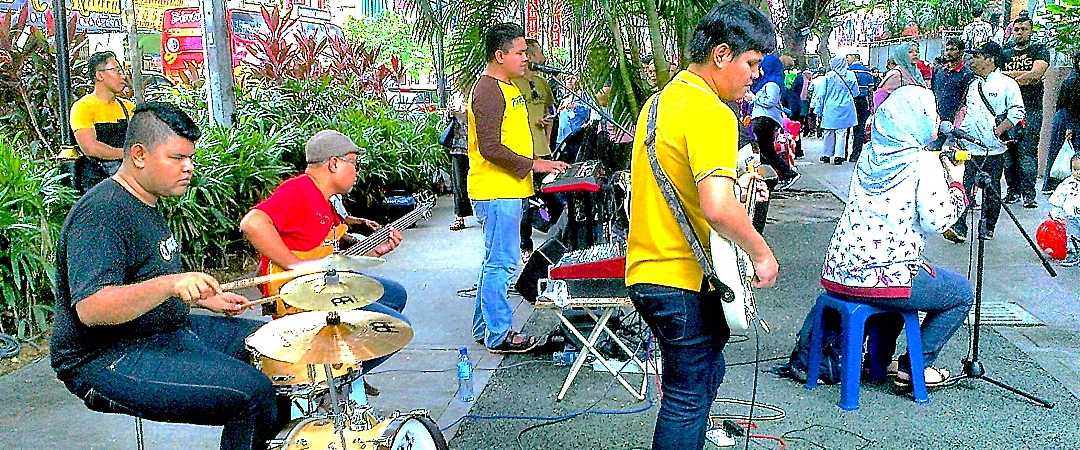
A pair of cropped images here, the top image is cropped to a 16:9 image aspect ratio, and the second is cropped to a 1:3 image aspect ratio.
The Fuji K-28 is a manual camera, though not autofocus like the Konica Genba Kantoku, or Fuji Work Record OP, and comes with a plain viewfinder, manual film advance, zone focusing, built-in electronic flash, and, the icing on the cake, a sealed Fujinon 28mm F3.9 lens.
The lens is 5 elements in a 5-group construction, with a minimum focus of 75cm to infinity. The automatic exposure system recognizes film sensitivities from ASA 100 to 400 ASA, and image capture is aperture controlled as the camera runs only on a single shutter speed of 1/100 second and a pair of AA batteries to operate the shutter and power the flash./p>
The film back is also opened with a press-to-release button, and film loading is the standard sprocket fit. With its purpose-built design, the Fuji K-28 might not be as compact as you want it to be. Its fair size may need to occupy a section of its own when carried in a backpack or camera bag.
The lens, an upgrade of the previous versions, is of a new lightweight design. This includes the use of aspherical optics and new mechanical construction. The internal focusing system and a non-rotating front barrel for convenient filter use of the previous version are, however, retained.
This compact and lightweight lens, with excellent imaging capability and easy to use, is rated highly by reviewers, which I agree with. A bit on the negative is that the lens's focus ring, though fast when used manually, is rather loose and sloppy.
Images were shot on a roll of recently expired Fuji Superia 200, scanned at 2400 bits, and were post-processed on Olympus Viewer 3 (OV3), with final print sharpening on Google NIK Sharpener Pro 3.
The 2.4:1 cinematic image aspect ratio, or anamorphic format, is a cinematography technique that shoots a widescreen picture on standard 35 mm film or other visual recording media with a non-widescreen native aspect ratio.
When projected, the 'distorted' images are again stretched through an anamorphic projection lens to recreate the original aspect ratio on the viewing screen.
While we do have mobile devices that are starting to use the 21:9 format, these images are not. They were shot on the Nokia Asha 300 at its native 4:3 image aspect ratio, post-processed, and cropped to the 2.4:1 image aspect on Olympus Viewer 3 (OV3). Final print sharpening was done on Google NIK Sharpener Pro3.
The lens is solid enough for a kit lens, has a zoom ring that is fairly smooth and not too sticky, is rather stiffer around the 28mm and 80mm ranges, and has a front element that wobbles a bit.
Getting the best of the lens means looking for the 'sweet spot', which should be around f/11 at its wide end, and at f/5.6 at the long end. Low cost and easy to find, the lens comes mostly included with an MZ/ZX type SLR, often listed on the auction sites. The lens should do well as a beginner or backup lens, though it might not end up as a keeper.
Images were shot on a roll of recently expired Fuji Superia 200, scanned at 2400 bits, and post-processed on Olympus Viewer 3 (OV3), with final print sharpening on Google NIK Sharpener Pro 3.