Search ImagingPixel for Images by Camera or Lens

Showing posts sorted by relevance for query two stops. Sort by date Show all posts

Monday, January 6, 2020

Nokia Asha 300, Scenes At The Stop II

Nokia Asha 300
Mobile Photography: Image making with a vintage candy-bar Nokia Asha 300, sights and scenes of an LRT and train interchange station.
<< Click on image for enlarged Lightbox display >>

Another two stops, actually. The first image, at the first stop, is the superstructure that roofs the elevated LRT stop, while the other images are some of the structural elements of the second stop, a railway station, located at ground level.

The connectivity between the two is a maze of architectural elements and engineering design, which to some might be a source of design inspiration, while to others, an intimidating solution.

Nokia Asha 300
Nokia Asha 300
Nokia Asha 300
Nokia Asha 300

Coupled with the time of day, which is much later than the morning rush hour, both had only a few people around, and the spaces were wide open to the imagination. The ease and fun of using a mobile device like the Nokia Asha 300 for telling stories are very apparent here.

Nokia Asha 300

It does not take more than slipping the camera out of your shorts or pants pocket and holding it away at arm's length to document, in essence, the aura and ambiance of the place.


Monday, April 3, 2017

Olympus LT Zoom 105, Colors of R&R Rest Stops

Olympus LT Zoom 105
Analog Diary: Film photography favorites, images with a vintage Olympus LT Zoom 105, a fully automatic retro aesthetic 35mm point-and-shoot film camera, with a 38-105mm (f/4.5-8.9) zoom lens, and a lightweight, splash-proof body.
<< Click on image for enlarged Lightbox display >>

The images here were shot at a couple of R&R Rest Stops on the East Coast Highway, which were only recently completed (the R&Rs) and opened to the public. With a highway that has very little traffic, the R&Rs are neither populated nor crowded.

Olympus LT Zoom 105
Olympus LT Zoom 105
Olympus LT Zoom 105
Olympus LT Zoom 105

The two that I stopped at have all the rest and recuperation facilities to cater to the public, but neither has all their food and refreshment outlets occupied and operating. Being fairly new means that the facilities and paintwork are still looking fresh and clean.

Olympus LT Zoom 105
Olympus LT Zoom 105 Panorama QD

The Olympus LT Zoom 105 Panorama QD is the final version of the LT (Leather Tech) series cameras introduced with the launch of the LT-1 (1995), LT-1 QD (1996), and the LT Zoom 105 (1997), and is fitted with a 38-105mm, f/4.5-8.9 zoom lens which focuses from 0.6m (2 feet) to infinity. How I wish that the camera were digital because then it would come with at least a 2.7-inch LCD instead of the minuscule diopter-corrected viewfinder, which is really a squint to use.


Monday, July 28, 2025

Olympus PEN E-P5, Sigma Super-Wide 24mm f/2.8

Olympus PEN E-P5, Sigma Super-Wide 24mm 1:2.8
Cameras and Lenses: Images with a vintage legacy Sigma Super-Wide 24mm f/2.8, a vintage prime lens known for its compact metal build, close-focusing macro capabilities, and high historical test ratings, a standard normal 48mm full-frame equivalent on the Olympus PEN E-P5.
<< Click on image for enlarged Lightbox display >>

I have had this low-cost, early version FD-mount Sigma Super-Wide 24mm f/2.8 for quite a while now, but was unable to get a close-fitting Micro Four Thirds adapter until only recently. A couple of earlier attempts were disasters, as the mounts were never a proper fit, shaking and wobbling when fitted to the adapter.

The Sigma Super-Wide 24mm 1:2.8 is a legacy lens acclaimed for its balance of affordability, optical performance, and versatility. Designed for the era of 35mm full-frame film cameras, this lens is now compatible with mirrorless camera systems through lens adapters.

Fitted to the 16MP CMOS Olympus PEN E-P5, the lens is equivalent to a 48mm prime on a 35mm full-frame camera, the focal length of a standard normal lens.

Olympus PEN E-P5, Sigma Super-Wide 24mm 1:2.8
Sigma Super-Wide 24mm 1:2.8

Lenses with a full-frame equivalent focal length of around 40 to 60mm have an angle of view and perspective similar to what the eye sees and, coupled with a fast 1:2.8 aperture, make the lens ideal for a wide range of photography genres, including landscapes, street photography, and architectural shots, or just as a general-purpose lens.

Olympus PEN E-P5, Sigma Super-Wide 24mm 1:2.8

The Sigma Super-Wide 24mm 1:2.8, which enjoys a rating of Sharpness (7.5), Aberrations (8.0), Bokeh (8.0), Handling (8.0), and Value (9.5) on PentaxForums, is said to have been introduced in 1981, with the follow-up Super-Wide II, with a plastic aperture ring, in 1986. The two are optically similar (if not identical) and share similar specifications, though reviews indicate that the II is slightly better in image contrast quality.

Olympus PEN E-P5, Sigma Super-Wide 24mm 1:2.8

The 6-bladed lens, which features a polycarbonate barrel with a metal mount, has an aperture range from f2.8 to f22 with half-click stops, a focus throw of 180 degrees, takes 52mm filters, and weighs around 195 grams, with variations according to the mount fitted. A standout feature of the lens is its 1:4 magnification ratio when set to its minimum focusing distance of 0.18 meters.

Olympus PEN E-P5, Sigma Super-Wide 24mm 1:2.8

Though the review unit is well past its 40th birthday, built without weather sealing and susceptible to dust and moisture ingress, it still has the optical clarity, albeit with minor exterior wear, of a mint. As a testament to its build quality, the focus ring is well-damped and very smooth, and aperture stops are clickety new. The lens should do equally well for APS-C digital SLR users looking for a cost-effective equivalent to a standard normal prime.

OOlympus PEN E-P5, Sigma Super-Wide 24mm 1:2.8
Olympus PEN E-P5, Sigma Super-Wide 24mm 1:2.8

The Olympus PEN E-P5, a 2013 issue, is the fourth iteration of the E-P model series, which continues with the updates with a 16MP MOS sensor (the same as seen on the  E-M5), an advanced '5-axis' in-body image stabilization with automatic panning detection, 9 fps continuous shooting, tilting rear touch screen, a top shutter speed of 1/8000 second, and a feature much sought after (of late) by vintage enthusiasts with legacy lenses - a 'peaking' display to assist manual focus.


Monday, July 3, 2017

Olympus LT Zoom 105, Highway R&R Stops

Olympus LT Zoom 105
Panoramas: Images with the Olympus LT Zoom 105 Panorama QD (1997), a stylish, weather-resistant 35mm point-and-shoot camera with a 38-105mm zoom lens.
<< Click on image for enlarged Lightbox display >>

A category of 35mm film cameras capable of taking panoramas is cameras with the crop-frame feature. These are normally full-frame 35 mm cameras with a switch or lever that activates a pair of blind or crop film gates that will reduce the 24 x 36 mm frame size to about 14mm x 36mm.

Olympus LT Zoom 105
Olympus LT Zoom 105
Olympus LT Zoom 105
Olympus LT Zoom 105
Olympus LT Zoom 105

The Olympus LT Zoom 105 QP is one of these cameras. The panorama switch lever is located at the back of the top plate, towards the left side of the body. When activated, the lever will not only set the film gate to the panoramic shooting position but will also activate another pair within the viewfinder window, making the viewfinder panoramic as well.

Olympus LT Zoom 105
Olympus LT Zoom 105 Panorama QD

As all images are still captured on the 24mm x 36mm film frame, you are free to switch between the two shooting modes - full-frame and cropped-frame panorama - on any frame you wish to do so. Aside from the diminutive viewfinder, the autofocus and fully automatic retro-style LT Zoom 105 with the Zuiko 38-105mm F4.5- 8.9 zoom lens are quite fun to use.


Monday, June 10, 2019

Lumix G 14mm f/2.5 Asph., On Microsoft Photos

Olympus PEN E-P5, Lumix G 14mm f/2.5 Asph.
Cameras and Lenses: Images with an early digital era lens, an ultra-compact pancake-style wide-angle prime Lumix G 14mm f/2.5 Asph., shot on an Olympus PEN E-P5, with edits post-processed on Microsoft Photos.
<< Click on image for enlarged Lightbox display >>

I do a fair amount of LRT (Light Rail Transport) hopping on the weekends, where I would first take the train, either to the city or in the opposite direction, dropping off at interconnecting stops along the line, to do the loop before coming back to join the main route I was originally on.

Olympus PEN E-P5, Lumix G 14mm f/2.5 Asph.

Back on the desktop, I am also warming up (rather slowly) to the new image-editing software from Olympus, Olympus Workspace, which replaced the older Olympus Viewer 3 (OV3) a few months back. Between the two, I do add edits with apps from a standalone version of Google NIK Collection and even Microsoft Photos in the process workflow.

Olympus PEN E-P5, Lumix G 14mm f/2.5 Asph.

The enhancements are done on the 'Filters' section of the apps, where you can go for automated enhancement by just clicking on the 'Enhance your photo' image, or go further and have the image rendered with the menu of filter effects.

Post-enhancing images on Microsoft Photos

The good part about using Microsoft Photos is that the app is installed with the version of Windows you are using. You can access the 'Edit & Create' interface by clicking on any image you have in your image folders, and using it is very easy and intuitive.


Monday, June 23, 2025

CCD Resurgence, Preserving the Cult

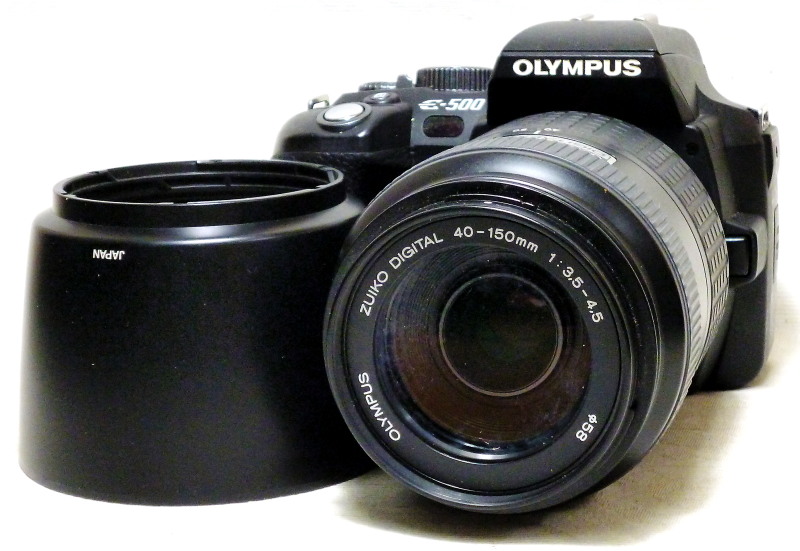
Olympus E-500, Zuiko Digital 40-150mm f/3.5-4.5
CCD Resurgence: The Olympus E-500 and the Zuiko Digital 40-150mm f/3.5-4, the perfect lightweight 80-300mm equivalent zoom kit for CCD enthusiasts.
<< Click on image for enlarged Lightbox display >>

If there is a call for a camera kit that CCD digital SLR camera enthusiasts would want to keep longer than most, my nomination will have to be an Olympus (Evolt) E-500, a Four/Thirds System digital SLR camera introduced in 2005, mounted with an Olympus Zuiko Digital 40-150mm 1:3.5-4.5 telephoto zoom lens, introduced in 2004.

This low-cost setup will not cost you an arm or a leg, and is a pleasure to use.

The Olympus (Evolt) E-500, a re-find in the resurgence of interest for the unique image characteristics, is a 10MP CCD Kodak KAF-8300CE Four/Thirds entry-level digital SLR camera designed to provide professional-quality features at an accessible price point.

Olympus E-500, Zuiko Digital 40-150mm f/3.5-4.5

The camera, with sensor performance that is particularly noteworthy for its generation, is compact and lightweight, praised for its solid build quality and ergonomic design, and image quality equated with excellent sharpness, color reproduction, and tonality.

The E-500 features a 2.5-inch LCD screen with 215,000 dots, with an active control panel that allows for quick access to most camera settings without diving into the menu system, a 49-zone metering system with Digital ESP, center-weighted, and spot metering modes, and a basic autofocus system with three focus points.

Olympus E-500, Zuiko Digital 40-150mm f/3.5-4.5

ISO range is from 100 to 400 as standard, with extended settings up to 1600; the shutter speed range is from 1/4000 to 60 seconds with a Bulb, and flash sync speed is 1/180 second. In burst mode, the E-500 can capture approximately 2.5 frames per second for up to five frames in Super High Quality JPEG mode.

Olympus E-500, Zuiko Digital 40-150mm f/3.5-4.5

The Olympus Zuiko Digital 40-150mm 1:3.5-4.5, a very affordable Four/Thirds mount option for vintage enthusiasts looking to add basic telephoto capabilities to their kit, is a versatile lens that offers an equivalent focal length of 80-300mm in 35mm terms on the 2x crop sensor E-500.

The lens is suitable for photography genres including portraits, sports, landscapes, and wildlife, and has also been a popular choice among Olympus DSLR users for many years.

Olympus E-500, Zuiko Digital 40-150mm f/3.5-4.5

The 13 elements in 10 groups lens, which offers impressive sharpness across most of its focal length range, more so when stopped a couple of f-stops down, has an aperture range from 1:3.5-4.5 to 1:22, 7 diaphragm blades, is 107mm x 77mm in size, weighs 425 grams, has a minimum focusing distance of 1.5 meters, and takes 58mm filters.

Though designed for smaller Four Thirds sensor cameras, this metal mount lens is comparatively large and heavier than some APS-C lenses as found on the market. What it does, however, is provide a positive feel when attached to the camera.

Olympus E-500, Zuiko Digital 40-150mm f/3.5-4.5

Using the camera and lens combination is easy and convenient. The E-500 has the standard PASM (Program, Aperture Priority, Shutter Priority, and Manual) exposure modes, an additional 15 scene modes, three color modes (Vivid, Natural, Muted), and two monochrome modes (Black & White, Sepia) that can be customized for contrast, saturation, and sharpness.

The lens, though slightly bulky, works well in good lighting conditions, delivers fast autofocus performance, and produces sharp, high-contrast images with signature Olympus colors and pleasing background blur, particularly with subjects at longer focal lengths.

Olympus E-500, Zuiko Digital 40-150mm f/3.5-4.5

Note: CCDs, known for producing images with a distinct color profile that many describe as more natural, vibrant, and film-like, with a smooth highlight roll-off, were the gold standard for camera sensors from the early 80s till the late 2000s.

While they have been largely displaced by the CMOS (Complementary Metal-Oxide-Semiconductor) variety in consumer digital cameras, CCDs are still valued for certain specialized applications, including Optical Microscopy, Space Photography, and Near-Infrared Imaging.


Popular on ImagingPixel