

The camera is praised for its robust, weather-sealed build, fast performance, and especially its stunning, saturated colors that make it great for vibrant images.
While newer cameras have surpassed its specs, the D200 offers a film-like experience, excellent detail, good high ISO performance, and is a bargain for its unique image quality and tactile, traditional controls.

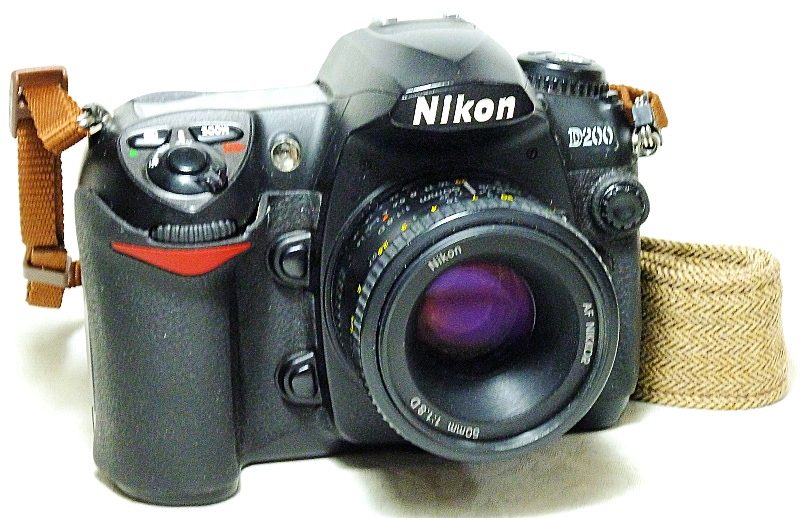
The D200, with its a 10.2 MP CCD sensor and seen here mounted with a AF-Nikkor 50mm 1:1.8D, has a shutter speed range from 30 to 1/8,000 seconds, an ISO range from 100 to 1,600, a top LCD panel for display of operating parameters, a 2.5 inch 230,00 pixels rear LCD, 7 area AF, operates in Program, Shutter priority, Aperture priority, and Manual modes, and captures images in JPEG and (NEF) RAW.

Designated as a professional model (see Nikon DSLR Timeline Chart on Wikipedia), it is a very well-built and robust DSLR camera with a magnesium alloy chassis, environmental seals, an excellent user interface, an exceptional feature set, and superior performance. The D200 can be used with AI manual focus and essentially all other Nikkor lenses manufactured from 1977 onward. It is also fitted with an intervalometer for time-lapse photography.

Taking on the cue from the flagship D2x, the menu system of the D200 is a very comprehensive array of function sets for Playback, Shooting, CSM (custom menus), and Set Up. Modifications to the Shooting or Custom Settings Menu (CSM for short) are saved to one of the four (4) Shooting Menu Banks, initially named A, B, C, and D. Images can be recorded in NEF (RAW) + JPEG (Fine, Normal, and Basic), RAW, or JPEG (Fine, Normal, and Basic) only, with a maximum size of 3872×2592 pixels.

The D200 is supported by a very bright, sharp, and smooth 2.5-inch 230,000-pixel LCD monitor with a very wide viewing angle, and a control panel dominating the right of the top plane, which provides a full range of information covering photographic and digital settings. The panel has a green backlight which can be illuminated by flicking the power switch to the lamp (right) position.

The D200 has two AF area modes, an 11-area Normal Zone and a 7-area Wide Zone, selectable via the AF-area mode switch on the lower back of the camera. In Normal Zone mode, which can be used mainly for static subjects, focus selection can be done from any one of the eleven areas, and the camera will focus on the center of the selected area. In Wide Zone mode, the focus is selected from any one of seven areas that cover a wider area of the frame, which is the more useful mode to focus on the general area of a moving subject.
The body weight of the D200 is a hefty 830 grams without a battery, memory card, body cap, or monitor cover. The power supply for the camera's operation is sourced from a Nikon EN-ELe3 Lithium battery pack, which also powers the Nikon D50, D70, D70s, D80, D90, D100, D300S, and D300.
While original battery packs may not hold their charge anymore, alternative replacements and chargers, if missing, are readily available from online stores.
Nikon AF-Nikkor 50mm 1:1.8D
A normal prime lens that has been the choice for decades, the AF-Nikkor 50mm 1:1.8D is one of the few items that you’ll find in both pro and amateur camera bags. The lens is compact, light, fast, easily available, and is always in demand at the auction markets, with prices that are normally higher than the asking price. On the D200, the AF-Nikkor 50mm 1:1.8D is equivalent to a 75mm short telephoto lens on a 35mm full-frame camera.


The 1:1.8 aperture lens is well-suited for a variety of lighting conditions, as well as effective for depth-of-field shots and pleasing bokeh quality with its rounded seven-blade iris. The lens also has SIC (Super Integrated Coating) applied to its individual elements. This helps reduce lens flare and ghosting and renders the image with increased contrast and color accuracy when working in bright and backlit conditions.
Early Images
While I have had the Nikon AF-Nikkor 50mm 1:1.8D for quite some time now, the Nikon D200 is a recent acquisition. The camera was only a low-cost purchase and came with a couple of basic faults, one mentioned in the listing and the other cropping up as I started using the camera. Otherwise, the camera works well, and I was happy with it.


The Nikon D200 is an awesome camera to learn and use, and while you can get away with a few basic shots after going through the Quick Tour, learning how to master the range of functions and true features that the camera has may take you a while longer.


In the hand, the D200 is solid as a brick, firm to hold with no creaks or any hint of flex, aided by the comfort of the soft rubber skin and chunky handgrip. Buttons are large, labels are clear, and the functional layout is excellent.


With the camera being past its 15th year of production, I can only assume that age does not matter with the CCD sensor, where images rendered are sharp, clear, and precise.


Guides and resources for users are readily available for download or read-through on the Net. A PDF copy of the 200+ Page User Manual of the Nikon D200 is available for download from the Nikon | Download Center.
The CCD Sensor
The CCD sensor, as we know it, was the standard for camera sensors from the early 80s till the late 2000s. The sensor was acknowledged for its high quality, low noise, and, as some say, film-like images. Though most digital cameras today are fitted with sensors of the CMOS variety, which are less costly to produce and use less power, CCD sensors are still the preferred sensor used in some regions of specialized photography, such as optical microscopy, space photography, and near-infrared imaging.

CMOS sensors, however, have an advantage over CCD sensors in terms of speed and performance because of their ability to allow faster data processing, higher frame rates, more autofocus points, and longer battery life. CCD sensors, on the other hand, can also offer good speed and performance, especially in low-light situations, where they can capture more light with reduced noise.


No comments:
Post a Comment